The background in a photograph is not a neutral element. It communicates mood, context, and intention just as clearly as the subject itself — and a poorly chosen or poorly managed backdrop can undermine a technically excellent shot completely. A creased muslin draping awkwardly behind a portrait subject, a distracting pattern competing with a product, a vinyl backdrop that catches reflections from the wrong direction — these are avoidable problems that come from not understanding your backdrop options and how to use them.
This guide covers everything a photographer needs to know about backdrops: what the different materials are and what each is genuinely suited to, how to choose the right size and colour for different subjects, how to hang and support a backdrop in both permanent and portable setups, how to build your own backdrops at minimal cost, and how to store and maintain them so they last.
What Is a Photography Backdrop?
A photography backdrop is any surface or material placed behind — and sometimes beneath — a subject to create a controlled, intentional background. It separates the subject visually from the surrounding environment, controls the tone and colour of the background, and contributes directly to the mood and context of the image.
The distinction between a backdrop and a background is worth clarifying: in general use they mean the same thing, but in photographic practice “backdrop” typically refers to a physical material — fabric, paper, vinyl, canvas — that is deliberately installed for a shoot. “Background” can mean either that physical material or the environmental background of any photograph, including uncontrolled natural or architectural environments.
Backdrops are used across portrait photography, product photography, newborn and family photography, school and event photography, fashion and editorial work, and video production. Each genre has specific backdrop requirements — both in terms of material properties and in terms of what visual qualities the backdrop should contribute to the final image.
Photography Backdrop Materials: A Complete Comparison
Paper Backdrops (Seamless Paper)
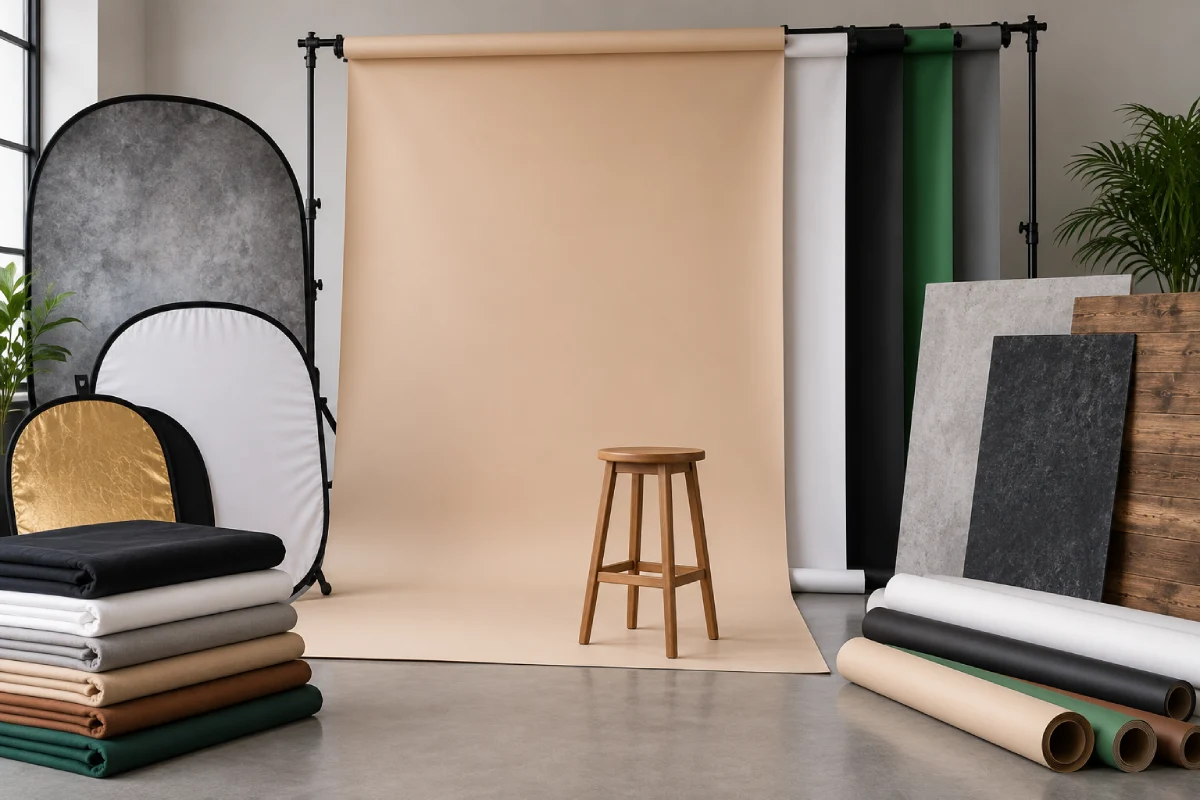
Seamless paper backdrop rolls are the studio standard for clean, continuous backgrounds with no visible seams, wrinkles, or texture. They are available in rolls typically 53 inches (135cm) or 107 inches (272cm) wide and in dozens of colours from every major supplier.
How they work: The paper unrolls from a holder mounted above the shooting position, creating a continuous sweep from the wall behind the subject down to the floor — the seamless curve at the base eliminates the harsh horizontal line between background and floor that would otherwise be visible. Subjects can stand on the paper itself, extending the background beneath them.
Advantages: Perfectly smooth surface with no texture or pattern, completely wrinkle-free when fresh, available in a wide range of colours, easy to tear off and replace when dirty or damaged, relatively affordable in bulk.
Limitations: Tears easily — particularly where subjects step on it. Cannot be cleaned. Once a section is damaged or dirty, it must be discarded. Not reusable in the way fabric backdrops are. Heavy rolls require appropriate mounting hardware.
Best for: Commercial and editorial photography where a perfectly clean, seamless background is required. Portrait studios with high client volume where the background needs to be pristine for every session. Catalogue e-commerce photography where consistent white or neutral backgrounds are the standard.
Recommended suppliers: Savage Universal, Colorama, Lastolite, and BD Company all produce high-quality seamless paper in wide colour ranges. Savage’s “Super White” and Colorama’s range are widely considered the industry benchmarks.
What size seamless paper do you need?
| Shoot Type | Minimum Width |
|---|---|
| Headshots (head and shoulders only) | 53 inches (135cm) |
| Half-body portraits | 53–107 inches (135–272cm) |
| Full-body portraits, single subject | 107 inches (272cm) |
| Full-body with movement or multiple subjects | 107 inches or wider |
| Product photography (small products) | 53 inches or smaller |
Fabric Backdrops
Fabric backdrops are the most diverse category — covering muslin, canvas, polyester, velvet, and various specialty fabrics, each with distinct properties.
Muslin: The most commonly used fabric backdrop material in portrait photography. Muslin is a plain-woven cotton fabric that drapes naturally, can be dyed in mottled or hand-painted patterns, and is machine washable. The woven texture produces a slight visual texture that reads in-camera as a soft, painterly quality — different from the perfectly smooth surface of seamless paper.
Muslin is available in hand-dyed versions (with irregular tonal variations that add visual depth and a painted quality) and in solid dyed versions. The hand-dyed mottled look — typically in warm brown, grey, or blue tones — has been a portrait photography standard for decades and remains popular for its classic, warm quality.
Polyester/microfibre: Modern photography backdrops made from polyester or microfibre are more crease-resistant than muslin, lighter, easier to transport, and often less expensive. They lack the painterly quality of muslin but are more practical for photographers who travel to locations or need a portable setup.
Velvet: Black velvet produces the deepest, most light-absorbing black background available. Because velvet’s pile absorbs light rather than reflecting it, it produces a true optical black that no other material matches — important for dramatic, low-key portrait work and for jewellery photography where a deep black background is required. Velvet is expensive, heavy, requires careful storage, and needs regular lint removal.
Canvas: A heavier woven fabric, canvas can be primed and hand-painted with oils or acrylics to create custom backgrounds of any colour, texture, or painted design. Canvas hand-painted backdrops are the premium choice for portrait photographers who want one-of-a-kind, artisan backgrounds — but they are significantly more expensive than muslin, heavy, and require careful storage to avoid cracking the paint.
Advantages of fabric backdrops generally: Reusable, washable (muslin and polyester), fold or roll for storage, wide variety of textures and appearances, can be used multiple times without replacement.
Limitations: Wrinkle easily in transport and storage, require steaming or careful rolling to maintain a smooth surface, heavier than paper for equivalent size.
Vinyl Backdrops
Vinyl backdrops are printed or solid-colour backgrounds on a vinyl or PVC substrate — waterproof, wipe-clean, and highly durable.
Printed vinyl backdrops replicate the appearance of textures and surfaces — wood grain, brick, concrete, stone, marble, bokeh patterns, environmental scenes — on a flat, portable surface. They are widely used in newborn photography, children’s photography, holiday mini-sessions, and school photography to create environmental backgrounds that would be impossible or impractical to shoot in real locations.
Solid colour vinyl is used primarily for product photography and as a practical alternative to seamless paper in high-traffic environments. Unlike paper, vinyl wipes clean and can be used repeatedly.
Advantages: Waterproof (particularly useful for newborn and baby photography where accidents are common), wipe-clean, highly durable, printed versions replicate complex environments convincingly.
Limitations: Heavy and bulky for transport in large sizes, can reflect light if not carefully positioned (creating unwanted hot spots), printed versions look artificial at close inspection or in full-resolution crops, cannot be ironed (heat damages the vinyl).
Handling vinyl backdrops: Never fold a vinyl backdrop — it creates permanent crease lines that catch light and are visible in photographs. Always roll vinyl backdrops around a tube for storage. To remove minor wrinkles from vinyl, lay flat in a warm room and allow gravity to pull out the creases, or use a hair dryer on very low heat from a distance — never direct heat on vinyl.
Digital Backdrops
Digital backdrops are not physical materials but photographic or illustrated backgrounds applied to images in post-processing. The subject is photographed in front of a uniform colour — typically green (greenscreen/chroma key) or white — and the background is replaced digitally in Photoshop, Luminar, or other editing software.
When digital backdrops are useful: Fantasy environments that cannot be physically created, extreme weather or seasonal scenes (snowy backgrounds in summer), historical settings, and any background that would be impractical or impossibly expensive to produce physically.
The technique requirements: Clean greenscreen or bluescreen shooting requires even, shadow-free illumination of the background, separation between subject and background (at least 3–4 feet to prevent green spill — reflected green light on the subject from the brightly-lit background), and consistent lighting on the subject. Poor greenscreen technique produces edges that look cut-out and artificial rather than naturally composited.
Limitations for serious photography: Digital backgrounds are immediately identifiable to any experienced viewer and look artificial in most portrait and commercial contexts where a natural appearance is expected. They are a practical tool in specific niches (newborn fantasy sessions, theatrical portrait work) but are not a substitute for physical backdrops in most professional contexts.
Choosing the Right Backdrop Colour
Colour choice is one of the most impactful backdrop decisions, affecting the mood, contrast, and overall reading of the image.
White Backdrops
White is the most versatile and most commonly used backdrop colour across almost every photography genre. It reflects light, brightens the overall scene, and provides maximum contrast for dark-haired or dark-clothed subjects. It is the required background colour for e-commerce product photography on most major platforms and the default for school and corporate portrait photography.
The challenge with white: Getting a true pure white background in-camera requires either very bright, even illumination of the backdrop (at least one stop brighter than the key light on the subject) or post-processing to push the background to pure white. Underlit white backdrops photograph as grey rather than white — a common problem in home studios where a single light source is being asked to do too much.
Grey Backdrops
Mid-grey is a popular alternative to white — it photographs more easily than white (it doesn’t require over-lit background to appear neutral, the way white does), provides a clean, modern look, and flatters a wide range of subject colouring and clothing. Particularly popular for corporate and professional headshot photography.
Black Backdrops
Black backgrounds produce dramatic, low-key images with strong subject isolation. They work best with subjects that have clear edges against the dark background — light-skinned subjects, blonde hair, light clothing — since dark-haired or dark-clothed subjects can merge with a black background. Velvet produces the deepest optical black; muslin and paper black backgrounds are somewhat less absorptive but still effective.
Coloured Backdrops
Colour selection beyond neutrals should be approached with the subject’s colouring in mind. Complementary colours (colours on opposite sides of the colour wheel from the subject’s dominant tones) create pleasing contrast. Analogous colours (similar tones) create a harmonious, less contrasty effect.
Practical colour guidance for portrait photography:
- Warm browns and tans: Flattering with warm skin tones, give a natural, earthy quality
- Deep blues and teals: Particularly flattering for fair or olive skin tones, popular in commercial portraiture
- Soft pastels: Suit children's photography, newborn sessions, and bright, airy aesthetics
- Deep greens: Work well for lifestyle and environmental portrait aesthetics
- Bold, saturated colours: Best used intentionally for editorial or artistic work rather than as default portrait backgrounds
What Colour Backdrop Is Best for Product Photography?
For most product photography, neutral backgrounds (white, light grey, or black) are the standard because they focus attention entirely on the product without adding visual noise. Brand-matched or complementary colour backgrounds are used in lifestyle product photography where the background contributes to brand identity.
How to Hang Photography Backdrops
Backdrop Support Systems
Freestanding backdrop stand: The most versatile option for both studio and location use. A standard backdrop stand consists of two adjustable vertical support poles (typically extending from 28 inches to 10 feet) and a horizontal crossbar. The crossbar accepts either a roll of seamless paper or a background clamp for fabric backdrops.
What to look for: Crossbar width should span wider than your backdrop material. Weight capacity matters — heavy canvas or wide seamless paper rolls are significant loads on the crossbar. Spring-loaded crossbars with locking mechanisms are more reliable than friction-fit versions. Brands: Savage, Neewer, Fotodiox, and Impact all produce reliable backdrop stand systems at different price points.
Wall-mounted backdrop system: A permanent installation where mounting tracks are fixed directly to the studio wall or ceiling, allowing multiple backdrop rolls to be hung simultaneously on a roller system and swapped quickly. Ideal for permanent studios where changing backgrounds quickly between clients is important.
Ceiling-mounted track systems: The professional standard for established studios — ceiling tracks allow any number of backgrounds to be mounted and rolled or dropped as needed. Installation requires appropriate ceiling height (minimum 10 feet for full-body portrait work) and structural anchoring to ceiling joists.
Improvised solutions for portable and budget setups:
- Two lightstand crossbar mount: Two light stands with a horizontal pole (such as a boom arm or a simple wooden dowel) stretched between them, with the backdrop draped over the crossbar. Effective and inexpensive, though less stable than dedicated backdrop stands.
- Clamps and a door frame: For small backgrounds used at head-and-shoulders distance only, clamping fabric to the top of a door frame or to a tension rod creates a workable background for headshots and small products.
- PVC pipe frame: Inexpensive PVC plumbing pipe cut to size and connected with corner and T-joints creates a lightweight, portable backdrop frame for under $20 in materials.
How to Hang Different Backdrop Types
Seamless paper: Thread the roll onto the crossbar through the cardboard core, extend the crossbar to the roll width, and roll out enough paper to create the sweep to the floor. Use gaffer tape or the roll’s cardboard floor guard to hold the paper in place at the base.
Fabric backdrops: Most fabric backdrops have rod pockets sewn along the top edge for threading onto a crossbar. Alternatives: bulldog clips or backdrop clamps grip the top edge of the fabric at multiple points along the crossbar.
Vinyl backdrops: Roll rather than fold vinyl backdrops, and unroll to hang — do not drape over a crossbar with a sharp bend at the crossbar edge. Use a wide crossbar or a tube over the crossbar to prevent the vinyl from creasing at the hanging point.
Backdrop Size Guide
Choosing the right backdrop size prevents the common problem of having visible edges of the backdrop in the frame — particularly with wide-angle lenses or full-body shots.
For Portrait Photography
Headshots and bust portraits: A 5×7 foot backdrop is sufficient for most headshot work. The subject fills a relatively small portion of the frame and the backdrop needs only to cover the area behind them.
Half-body portraits: A 6×9 foot backdrop works for most half-body work with standard to short telephoto focal lengths.
Full-body portraits, single subject: 8×10 foot is the practical minimum. 9×12 foot provides comfortable margin for repositioning the subject without the backdrop edges entering the frame.
Multiple subjects or movement: 10×12 foot or wider. For group portraits or sessions involving significant movement (dance, athletics, fashion), the backdrop must be wide enough to accommodate the subjects at their widest positions.
For Product Photography
Product photography backdrops are typically much smaller than portrait backdrops:
- Small products (jewellery, cosmetics, accessories): A 24×24 inch sweep is sufficient
- Medium products (bottles, shoes, electronics): 32×40 inch sweep
- Large products (bags, small appliances, footwear): 48×60 inch sweep
- Full outfit or mannequin photography: Same requirements as portrait — minimum 5×7 feet
For Newborn Photography
Newborn photography uses both full portrait-sized backdrops for environmental setups and smaller wraps and textured surfaces for close-up posed work. A 5×7 foot backdrop covers most newborn full setups; a 3×5 foot backdrop is sufficient for posed newborn shots where the baby occupies only a small central area of the frame.
DIY Photography Backdrops
Making your own backdrops allows complete creative control over colour, texture, and style at a fraction of the cost of commercial alternatives. Here are the most practical DIY approaches:
Painted Canvas Backdrops
Materials: Cotton canvas duck (available from art supply stores or online, priced around $2–$5 per yard), acrylic or latex paint, wide paintbrushes, optional texturing tools (sponges, rags, plastic wrap).
Basic construction:
- Hem or serge the edges of the canvas to prevent fraying, and sew or fold a rod pocket along the top edge for hanging
- Wet the canvas slightly before painting — this helps the paint absorb evenly and reduces hard edges
- Apply a base coat in your primary background colour (grey, brown, dark teal are popular starting points)
- While still wet, use a large brush, sponge, or scrunched plastic wrap to add tonal variation — lighter areas, darker areas, subtle streaks — that create the mottled, hand-painted quality characteristic of classic portrait backdrops
- Allow to dry completely before rolling for storage
Colour mixing guidance: Mixing a small amount of the complementary colour into each tone variation prevents the final backdrop from looking overly flat or monochromatic. A grey backdrop that mixes warm and cool tones has more visual depth than a single-temperature grey.
Fabric Panel Backdrops
Inexpensive fabric from a craft or fabric store — canvas, muslin, cotton broadcloth, even bed sheets for softer textures — can be used directly as backdrop material without any painting or treatment. The natural texture of the fabric adds visual interest, and the fabric can be dyed using standard fabric dyes for custom colours.
Tip for seamless appearance: Iron or steam fabric thoroughly before use, and hang with enough tension that gravity pulls out any remaining wrinkles. A smooth, taut fabric background photographs with far less apparent texture than a wrinkled or loosely hung one.
Paper and Cardboard Backdrops
Large sheets of craft paper, kraft paper, or art paper from a stationery or craft store provide inexpensive, disposable backgrounds for product photography. Mount on MDF boards of appropriate size for stability and easy swapping.
Cardboard, foam core board, and art paper can all be painted, stamped, or textured to create specific backdrop appearances. These are particularly useful for building a collection of small (24×24 inch) product photography surfaces at minimal cost.
How to Store Photography Backdrops
Proper storage significantly extends the lifespan of fabric and vinyl backdrops and reduces the time spent dealing with wrinkles before shoots.
Rolling vs Folding
Always roll, never fold, vinyl backdrops. Folding vinyl creates permanent crease lines that are nearly impossible to remove and are visible in every subsequent photograph.
Roll fabric backdrops around a tube when possible. A length of PVC pipe, a pool noodle, or a cardboard postal tube of appropriate diameter makes a useful rolling core. Rolling prevents the sharp creases that folding creates.
If fabric backdrops must be folded (for transport or limited storage space), fold along the same lines consistently and store in a way that minimises pressure on the fold lines. Steam or hang to release fold creases before shooting.
Storage Environment
Store backdrops in a cool, dry environment away from direct sunlight. Prolonged UV exposure fades colours — particularly relevant for muslin and fabric backdrops stored near windows or in bright studio spaces. A dark cupboard, a backdrop bag, or a dedicated backdrop storage rack (horizontal rolling storage) are all appropriate options.
Keep backdrops away from moisture and humidity to prevent mould growth — particularly relevant for natural fibre backdrops like cotton muslin in humid climates.
How to Remove Wrinkles From Photography Backdrops
Wrinkles are the most common and most frustrating backdrop problem. The solution depends on the material:
Steaming (Recommended for Most Fabric Backdrops)
A clothing steamer or garment steamer is the fastest and most effective way to remove wrinkles from muslin, polyester, and cotton backdrops. Hang the backdrop vertically, work the steamer nozzle slowly down the fabric at a distance of 1–2 inches, and the wrinkles release as the fibres relax. A full-size 8×10 foot backdrop can typically be completely wrinkle-free within 10–15 minutes of steaming.
Ironing
Most cotton and linen-type fabric backdrops can be ironed on a medium heat setting (without steam, to avoid damp patches that photograph as dark spots). Iron on the reverse side of the fabric to prevent any shine on textured surfaces. Never iron vinyl — heat will warp, melt, or permanently damage vinyl backdrops.
Hanging and Time
For minor wrinkles in fabric backdrops, hanging the backdrop vertically for 24–48 hours before the shoot allows gravity to pull out most creases, particularly in heavier fabrics like canvas and muslin. In a humid environment, the moisture in the air helps relax fibres — some photographers hang fabric backdrops in a bathroom during a hot shower for a DIY steam treatment.
Handling Vinyl Crease Lines
Once a vinyl backdrop has permanent crease lines from improper folding, they are very difficult to remove completely. A hair dryer on the lowest heat setting from a distance of 12 inches or more, applied gradually to the crease area while gently stretching the vinyl, can reduce (but rarely eliminate) deep crease lines. Prevention through correct storage — always rolled, never folded — is the only reliable solution.
Lighting Your Backdrop
The backdrop is not just a physical surface — the way it is lit determines how it reads in the final image. Several important principles:
Separate your subject from your backdrop. Placing your subject at least 4–6 feet from the backdrop creates physical and optical separation — the backdrop falls further out of focus, and light falling on the subject is less likely to spill onto the backdrop and create unwanted gradients.
Light the backdrop independently when needed. For pure white backgrounds, add a dedicated backdrop light (positioned behind the subject, aimed at the backdrop) to ensure even, bright illumination across the full backdrop surface. For dark or coloured backgrounds, control carefully which lights illuminate the backdrop to maintain the intended tone.
Watch for colour spill. Coloured backdrops reflect coloured light onto nearby subjects. A deep red backdrop will cast a red tint onto a subject standing close to it. Maintaining subject-to-backdrop distance reduces colour spill; positioning the key light to overpower the reflected colour eliminates it.
Gradient effects. Deliberately lighting one side of a grey or white backdrop more brightly than the other creates a graduated tone — darker on one side, brighter on the other — that adds visual interest and depth to an otherwise flat background. This is achievable with a single off-axis light or with a purpose-built background gradient lighting setup.
Further Reading
For the complete picture on setting up controlled studio lighting that works alongside backdrop setups, our guide to light modifiers for portrait photography covers softboxes, reflectors, and studio lighting configurations in practical depth. For using backdrops specifically in product photography contexts, our guide to lightbox and softbox photography covers the full controlled-light product photography setup. For portrait photography where backdrop selection is one of the key craft decisions, our portrait photography guide covers the complete portrait workflow.
For purchasing, Savage Universal and Colorama are the two most widely recommended seamless paper backdrop suppliers among professional photographers. For fabric and specialty backdrops, Photography Backdrops by Kate and Backdrop Express offer extensive ranges at accessible price points.
Final Thoughts
A photography backdrop is one of the simplest and most impactful ways to control what a photograph communicates. The difference between a portrait shot against a wrinkled bedsheet hung behind the subject and the same portrait shot against a properly installed, correctly lit muslin backdrop is not subtle — it is immediately and completely apparent to any viewer.
The investment in understanding your backdrop options — whether that means building a DIY canvas, buying a roll of seamless paper, or setting up a proper vinyl printing backdrop for a specific niche — pays back directly in the quality and professionalism of every image you produce from that point forward. The backdrop is not an afterthought. It is half the photograph.

Charles is a passionate photographer and visual storyteller with a keen eye for capturing authentic moments and timeless emotions. Through here, he combines creativity, technical expertise, and a love for natural storytelling to create images that preserve life’s most meaningful memories. His work focuses on genuine connections, beautiful details, and the unique stories behind every photograph.