Most US couples pay between $1,500 and $4,700 for wedding photography, and the average is about $3,000. That figure comes from The Knot’s 2026 Real Weddings Study, which surveyed 10,474 couples who married in 2025. For a full day with an established professional, $4,000 to $6,000 is common.
Where you land in that range depends on four things: how many hours you book, where you marry, the photographer’s experience, and what you add on (a second shooter, an engagement session, an album). This guide breaks down each one with real numbers. It also explains what the fee pays for and how to spend less without losing the photos you care about.
If you are a photographer working out your own rates, skip to the section for photographers near the end.
Average Wedding Photography Cost in 2026
The best single number is $3,000, but each major source measures something slightly different. Survey averages of what couples paid run lower than what full-time professionals list for a full day.
| Source | Average | What it measures |
|---|---|---|
| The Knot Real Weddings Study | $3,000 | What 10,474 US couples married in 2025 actually paid |
| WeddingWire Cost Guide | ~$2,000 | Spend reported by couples in vendor reviews; most paid $1,150–$3,000 |
| Fearless Photographers 2025 survey | ~$5,800 | Standard ~10-hour package quoted by 138 professional wedding photographers |
| Thumbtack | ~$150/hour | Hourly rates quoted on its marketplace; range $122–$450/hour |
Why the spread? The Knot and WeddingWire include everyone couples hired, from part-timers to studios. Fearless Photographers surveys award-winning professionals quoting a full day with 600–1,000 edited images. Thumbtack skews toward shorter, lower-cost bookings.
The Knot’s quartiles give the clearest picture of the market:
- Budget (lower quartile): about $1,500
- Mid-range (median): about $2,800
- Premium (upper quartile): about $4,700 and up
So if a quote lands between $2,500 and $4,000, you are paying the going rate. Below $1,500 usually means a newer photographer or fewer hours. Above $5,000 usually means a sought-after name, a second shooter and an album.
What You Get at Each Price Level
Price tracks experience and hours more than anything else. These tiers use The Knot’s quartiles and Fearless Photographers’ professional survey as anchors; individual quotes will vary.
| Tier | Typical price | Usually includes | Best for |
|---|---|---|---|
| Budget | Under $1,500 | 3–6 hours, one photographer, online gallery | Elopements, courthouse and small weddings |
| Mid-range | $1,500–$3,500 | 6–8 hours, edited gallery, sometimes an engagement session | Most traditional weddings |
| Established pro | $3,500–$6,000 | 8–10 hours, second shooter, 600–1,000 edited images | Larger weddings, couples who rank photos as a top priority |
| Luxury / in-demand | $6,000+ | Full weekend or destination coverage, heirloom album, two photographers | High-end venues, destination weddings |
Thumbtack’s sample packages show how this scales in practice. One photographer listed $1,000 for four hours, $1,400 for six, $2,600 for eight, and $3,000 for ten hours with a 26-page album (Thumbtack).
Guest count matters too. Bigger weddings need more coverage and more editing. The Knot found couples with 1–50 guests paid about $2,000, those with 51–100 paid about $2,700, and those with 101+ guests paid about $3,500.
Wedding Photography Cost by Region
The Northeast and Mid-Atlantic are the most expensive places to hire a wedding photographer; the Southwest is the least. Here are The Knot’s 2025 regional averages:
| Region | Average cost |
|---|---|
| Mid-Atlantic | $3,800 |
| Northeast / New England | $3,700 |
| Midwest | $2,900 |
| West | $2,900 |
| South / Southeast | $2,700 |
| Southwest | $2,600 |
Source: The Knot.
City matters even more than region. Photographers in major metros such as New York, Boston, San Francisco and Los Angeles face higher rent, insurance and living costs, and their prices reflect that. A photographer two hours outside the city often charges noticeably less, even after a travel fee.
Travel fees. Many photographers include local travel and charge mileage beyond a set radius. WeddingWire notes fees of up to $2 per mile once a wedding is more than about 60 miles away (WeddingWire). For destination weddings, you will usually cover flights, lodging and meals on top of the package.
What Drives the Price Up (or Down)
Hours of coverage are the biggest lever, followed by the photographer’s demand and what you add on. Here is what moves a quote.
- Hours of coverage. Most full-day packages run 8–10 hours, from getting ready through the first dances. Cutting to six hours, starting at the ceremony and ending after toasts, is the fastest way to lower the price.
- Experience and demand. A photographer booking 30+ weddings a year from referrals can charge more than one building a portfolio. You are paying for consistency: knowing they will get the shot when the light is bad or the timeline slips. Always review full wedding galleries, not just highlights; our photography portfolio guide explains what a strong body of work looks like.
- A second shooter. A second photographer captures both partners getting ready at once, guest reactions during the ceremony and a second angle on key moments. WeddingWire reports that 34% of photographers include one in their starting rate; for the rest it is an add-on.
- Engagement session. Often bundled into mid-range and premium packages. It doubles as a chance to get comfortable in front of the camera before the wedding day.
- Albums and prints. A professionally designed album is one of the most expensive add-ons, and quality varies hugely between lab-printed books and handmade heirloom albums.
- Season and day of week. Saturdays from May to October are peak dates. Many photographers discount Fridays, Sundays and winter weddings to fill their calendar.
- Style and editing. Heavily retouched, fine-art editing takes more hours per image than a clean documentary edit. Turnaround time matters too; rush delivery usually costs extra.
- Gear and backup. Professionals shoot with two camera bodies, dual card slots and fast lenses so a single failure never costs you your ceremony. See our guide to wedding photography lenses for the kit a working pro carries.
Hourly Rates and Add-On Costs
Wedding photographers average around $150–$375 an hour, depending on how you measure. Thumbtack’s marketplace average is about $150/hour (range $122–$450), while The Knot’s $3,000 average works out to roughly $375/hour over an eight-hour day. The gap exists because a wedding hour includes editing, planning and delivery time, not just shooting.
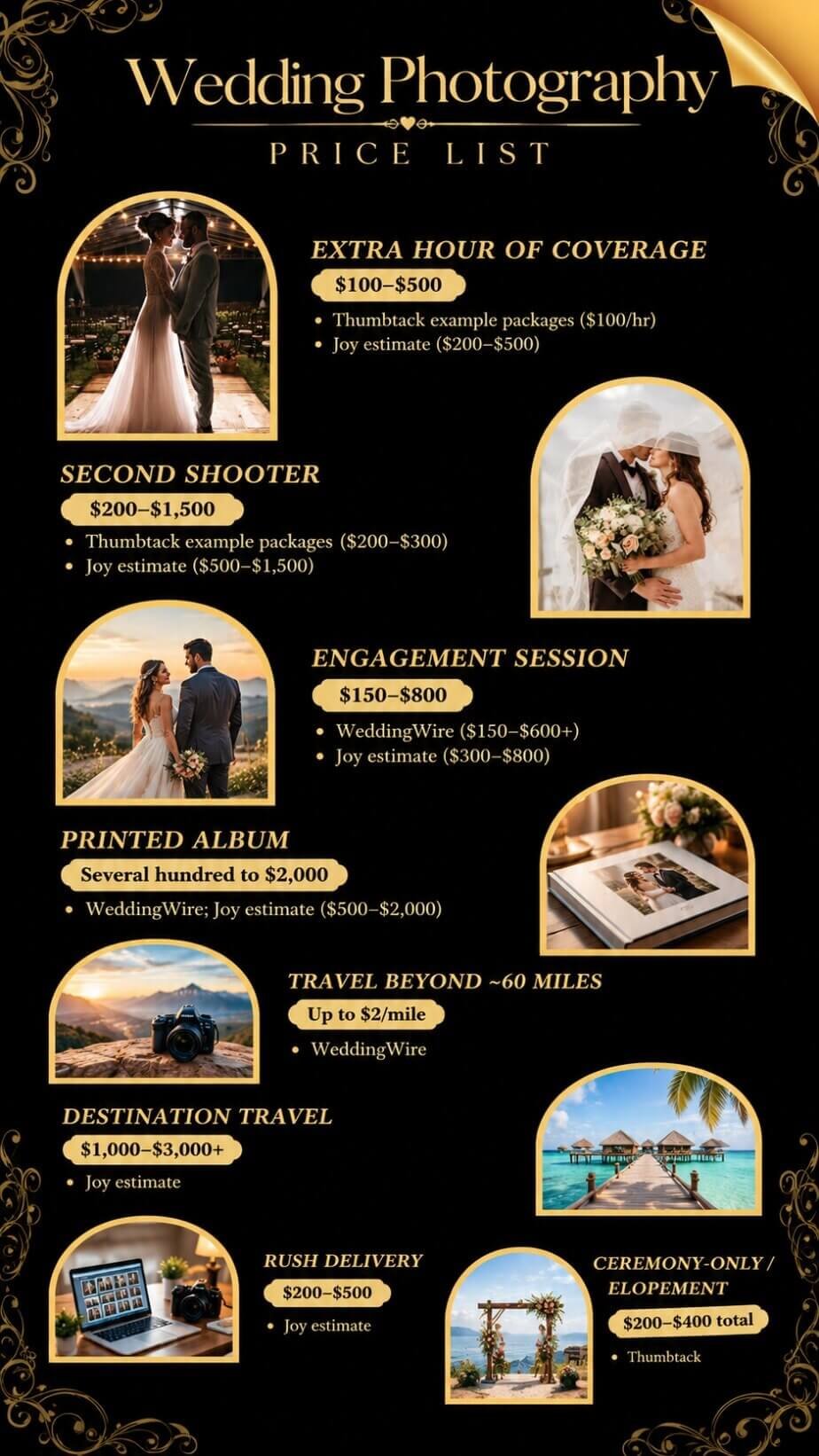
Typical add-on prices:
| Add-on | Typical cost | Source |
|---|---|---|
| Extra hour of coverage | $100–$500 | Thumbtack example packages ($100/hr); Joy estimate ($200–$500) |
| Second shooter | $200–$1,500 | Thumbtack example packages ($200–$300); Joy estimate ($500–$1,500) |
| Engagement session | $150–$800 | WeddingWire ($150–$600+); Joy estimate ($300–$800) |
| Printed album | Several hundred to $2,000 | WeddingWire; Joy estimate ($500–$2,000) |
| Travel beyond ~60 miles | Up to $2/mile | WeddingWire |
| Destination travel | $1,000–$3,000+ | Joy estimate |
| Rush delivery | $200–$500 | Joy estimate |
| Ceremony-only / elopement | $200–$400 total | Thumbtack |
Sources: Thumbtack, WeddingWire, Joy 2026 cost guide (editorial estimates, no survey cited). The low ends reflect budget marketplace packages; established professionals typically sit at the upper end.
Don’t forget the tip. Tipping isn’t required, especially if the photographer owns the business, but WeddingWire suggests $100–$200 when you want to say thanks. Budget it alongside other vendor tips.
Why Wedding Photography Costs What It Does
The wedding day is only a fraction of the work you are paying for. An eight-hour wedding typically turns into several days of total labor once you count everything around it. A rough, typical breakdown looks like this:
- Before the wedding: inquiry calls, contract, timeline planning, a venue scout and often an engagement shoot.
- The wedding day: 8–10 hours on site, plus travel and setup.
- After the wedding: backing up files, culling thousands of frames down to the best several hundred, editing each image, building the gallery and designing the album.
Then there are the running costs of the business: professional camera bodies, lenses, lighting, backup drives, insurance, editing software, a website and marketing. One photographer interviewed by The Knot said they spend about $2,400 a month on more than 12 software subscriptions alone. Self-employed photographers also pay their own taxes, health cover and retirement savings out of that fee.
Put simply, a $3,000 fee is not $375 an hour of take-home pay. Spread across all the hours and overheads, many wedding photographers earn far less per hour than couples assume. That’s why the cheapest quote is rarely a bargain: very low prices usually mean less experience, less backup gear or no insurance.
How to Save on Wedding Photography Without Regrets
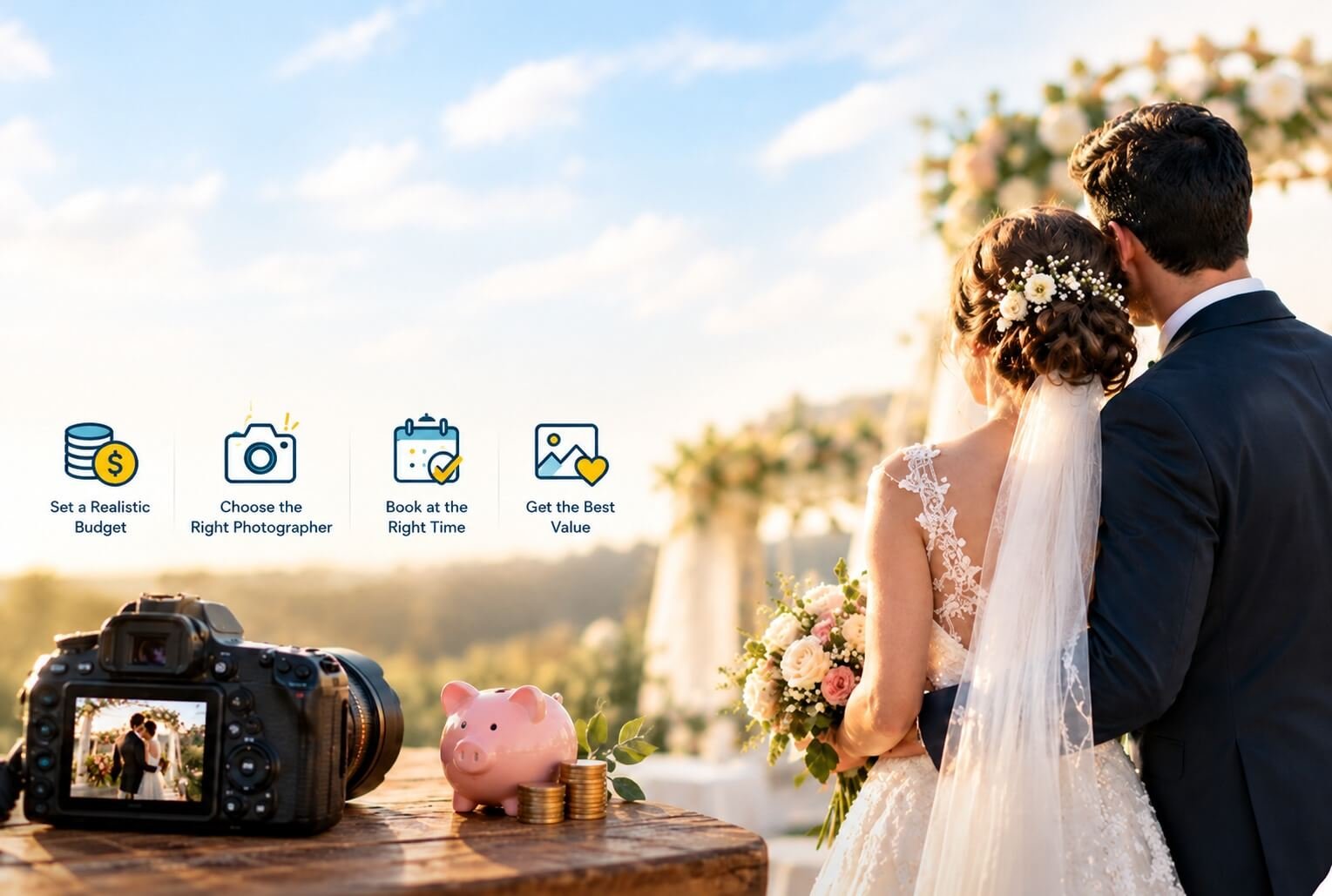
The smartest savings cut hours and extras, not quality. Photos are one of the few things from the day you keep for life, so protect the core and trim around it.
- Book fewer hours. Skip getting-ready coverage or end after the first dance and toasts. Six well-planned hours can capture everything that matters.
- Choose an off-peak date. Friday, Sunday and winter weddings are often discounted.
- Do the engagement shoot yourself or skip it. If budget is tight, put that money toward coverage on the day.
- Order the album later. Most photographers let you buy one after the wedding, once you know which images you love.
- Drop the second shooter for small weddings. Under about 50 guests, one skilled photographer can usually cover it.
- Hire a talented newer photographer. Look for someone with full wedding galleries (not just styled shoots), solid reviews and backup gear. Many are excellent and still building their prices.
- Plan a tight timeline. Group family photos with a shot list and keep the venues close, so paid hours go to photos, not waiting.
What not to cut: a contract, backup equipment, and a photographer whose full galleries you have actually seen. A friend with a good camera is a real risk if they have never shot a wedding.
Questions to Ask Before You Book
A quote only means something once you know exactly what it includes. Ask every photographer on your shortlist:
- How many hours are included, and what does an extra hour cost?
- Is a second shooter included, or what does one cost?
- Roughly how many edited images will we receive, and when?
- How are images delivered, and for how long is the online gallery hosted?
- Who owns the copyright, and what are we allowed to do with the photos (print, share, publish)?
- Is an engagement session or album included? What do they cost separately?
- Are travel fees included for our venue?
- What deposit is due, and what is the cancellation or rescheduling policy?
- What backup gear do you bring, and how do you back up files after the wedding?
- Do you carry liability insurance? (Many venues require it.)
- Can we see two or three c
Red flags: no written contract, only highlight images and no full galleries, no backup camera, pressure to pay in full upfront, or a price far below everyone else with no clear reason.
For Photographers: How to Set Your Wedding Prices
Price from your costs and goals first, then check against the market, never the other way round. The averages above tell you what couples expect to pay, not what you need to earn.
- Add up your annual costs: gear and its replacement, insurance, software, website, marketing, travel, and taxes.
- Set an income target and decide how many weddings you can realistically shoot and edit well in a year.
- Divide (costs + income) by that number of weddings. That’s your minimum average fee per wedding.
- Compare it with your local market using the regional figures above, and position yourself on portfolio quality and service, not on being cheapest.
- Build three packages (for example 6, 8 and 10 hours) so couples choose between your options rather than between you and a competitor.
Newer photographers often start near the lower quartile to build a portfolio, then raise prices as bookings and referrals grow. For the full method, read our photography pricing guide, and see how to market your photography business to fill your calendar at the rate you set.
Frequently Asked Questions
How much does wedding photography cost on average?
About $3,000 in the US, based on The Knot’s survey of couples married in 2025. Most couples pay between $1,500 and $4,700.
How much is a wedding photographer per hour?
Marketplace rates average around $150 an hour (range $122–$450) on Thumbtack. Full-day packages work out to roughly $300–$400 an hour because they include editing and delivery.
How much should I spend on a wedding photographer?
A common approach is to set aside about 8–10% of your total budget. Against Zola’s projected $36,000 average wedding for 2025, the $3,000 photography average is a little over 8%. If photos are your top priority, spend more and trim elsewhere.
How much does a second shooter cost?
Anywhere from about $200 in budget packages to $1,500 with established studios. Some photographers include one as standard.
How many hours of wedding photography do I need?
Eight hours covers most traditional weddings from getting ready to the first dances. Six hours suits smaller weddings; 10+ hours suits large or multi-location days.
Why are wedding photographers so expensive?
The fee covers days of planning and editing, professional backup gear, insurance, software and taxes, not just the hours on site.
Is it cheaper to hire a photographer for just the ceremony?
Yes. Thumbtack lists ceremony-only and elopement coverage from about $200–$400.
When should I book a wedding photographer?
As soon as your date and venue are confirmed. In-demand photographers often book peak Saturdays a year or more ahead.
Final Thoughts
Expect to pay around $3,000 for wedding photography in the US, with $2,500–$4,000 the sweet spot for an experienced professional and more for a second shooter, album or major city. Decide what matters most to you, whether that’s hours of coverage, a particular style or a printed album, and put your money there. Then choose the photographer whose full galleries you love and whose contract spells out exactly what you are getting.

Charles is a passionate photographer and visual storyteller with a keen eye for capturing authentic moments and timeless emotions. Through here, he combines creativity, technical expertise, and a love for natural storytelling to create images that preserve life’s most meaningful memories. His work focuses on genuine connections, beautiful details, and the unique stories behind every photograph.